AI Agent Skills Are Know-How, Not Just Prompt Files
A tool can expose an action. It cannot tell an agent how to perform the work around that action. That missing layer is procedure.
- AI agent skills
- procedural know-how
- AI agent packaging
- agent package manager
- agent interoperability
- agent system architecture
- agentpm
AI Agent Skills Are Know-How, Not Just Prompt Files#
A Slack posting tool exists. The agent can call it. The message still comes out wrong.
Not because the tool failed. It posted the message.
It failed because the agent did not know the procedure. It did not know to summarize current state before making a recommendation. It did not know to name the incident owner, call out severity, list known unknowns, note the next checkpoint, avoid false certainty, and route the update to the right audience. The action was available. The know-how was not.
That is not a tool problem. It is a procedure problem.
This distinction matters more as agent systems grow. The first generation of agent infrastructure focused on executable capability: tools, APIs, function calling, MCP servers, wrappers, adapters. That work was necessary. But it only covers one part of behavior. It answers the question, what can this agent do? It does not answer, how should this agent do the work?
That second question is where many real failures live.
Research on large tool spaces has made the pattern hard to ignore. When agents are stressed with dozens or hundreds of tools, performance can drop sharply, not because the tools stopped working, but because selection, context pressure, and instruction quality break down.[1][2][3] Microsoft Research has documented how tool-space interference degrades agent performance as tool counts scale.[2] Other teams have documented similar cliff effects once agents pass a few dozen tools.[1][3] Meanwhile, empirical work on tool descriptions shows that most tool metadata in the wild is noisy, unclear, or incomplete.[4] More tool definitions do not automatically produce better behavior. Often they produce worse behavior.[2][4]
The action is not the procedure.
If a team wants consistent incident handoffs, issue triage, support escalation, or research briefs, giving an agent a pile of tools is not enough. It needs the procedural layer that explains when to use those tools, in what order, with what constraints, and what a good result should look like.
That layer exists in most teams already. It just does not have a proper home.
Why AI Agent Behavior Breaks Without a Procedure Layer#
Today, agent know-how usually lives in fragile places:
- system prompts
- README snippets
- app-specific markdown files
- comments in source code
- example conversations
- framework config
- local prompt folders
- tribal knowledge passed between teammates
This works for experiments. It does not scale when behavior needs to be reused, versioned, governed, or shared across apps and teams.[5][6][7]
The failure modes are familiar:
- the best guidance is buried inside one app’s prompt
- another team rebuilds the same behavior by hand
- a local fix never becomes reusable
- no one knows which version of the procedure an agent is following
- behavior changes when the prompt is edited, but nothing about that change is visible in the dependency graph
- an app can depend on a tool package, but not on the operational procedure that makes the tool useful
This is part of why agent behavior often feels local and brittle. The code travels. The procedure does not.
That matters because the procedural layer is often what makes the system useful in practice. A support assistant is not useful because it can hit an API. It is useful because it knows how to gather facts, decide whether to escalate, avoid over-promising, and draft a response in the right tone. A maintainer copilot is not useful because it can comment on a GitHub issue. It is useful because it knows when an issue is stale, when clarification is needed, and when a write action should stop for approval. Context drift and memory loss are a major part of why this breaks in production.[5]
If that guidance changes how an agent performs the work, it should not be trapped as invisible glue.
This is the point behind Skills.
AI Agent Skills Are the Missing Artifact Layer#
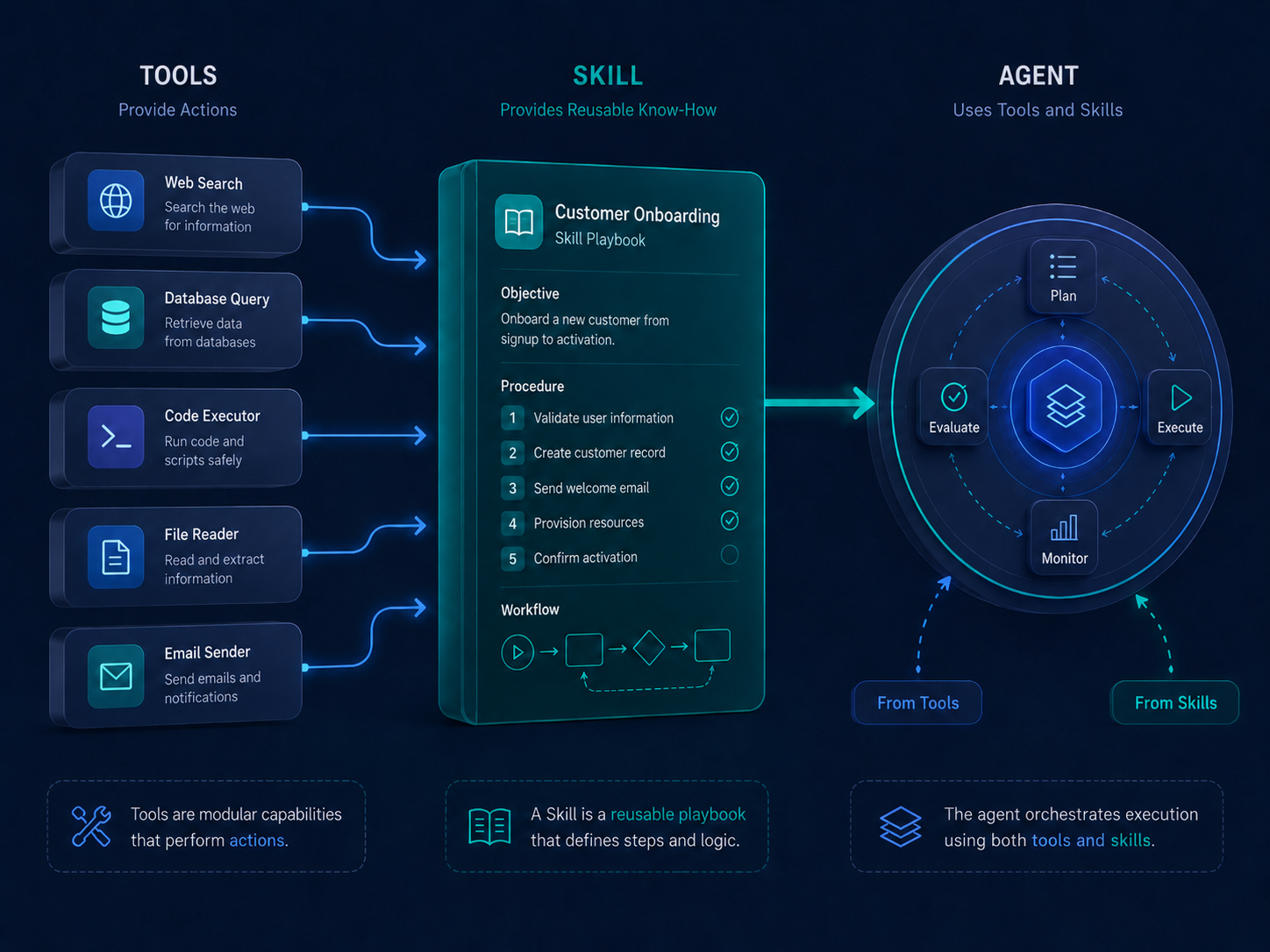
The cleanest way to think about the agent stack is as four different artifact layers:
Tool     = executable capability
Skill    = procedural know-how
Agent    = composition and orchestration
Template = starter system
Each layer answers a different question.
A Tool answers: what action can the system invoke?
A Skill answers: how should the work be done?
An Agent answers: how are procedures and capabilities composed into a reusable runtime unit?
A Template answers: how do we bootstrap a working project from those parts?
This is the gap Skills fill. A Skill is not just documentation and not just a prompt fragment. It is a reusable package of operational know-how:
- the steps for performing a class of work
- the decision criteria at each step
- the constraints that matter
- the tools the procedure expects
- what good output looks like
- when to escalate, stop, or ask for review
That can describe many real artifacts:
- an incident handoff checklist
- an issue triage playbook
- a research brief procedure
- a support escalation review workflow
- a release notes drafting guide
The important boundary is that a Skill is not executable in the same way a tool is executable. A Skill does not become a new runtime. It guides behavior. The agent or app still decides how to orchestrate, and the tools still perform the actual work. That separation lines up with broader research on externalization in agent systems, where skills, memory, and protocols are treated as distinct layers from raw executable capability.[6]
That is a feature, not a limitation.
Tools should stay focused on actions. Skills should stay focused on procedure. Blurring the two usually makes both worse.
What First-Class AI Agent Skills Enable#
The difference between a local markdown file and a first-class Skill is not philosophical. It is operational.
A local markdown file can help one app. A first-class Skill can move across projects.
Once a Skill is treated as a package, it can be:
- named
- versioned
- published
- installed
- searched
- rendered in a registry
- loaded by SDKs
- connected to the tools it depends on
- reused by multiple agents and templates
That changes the portability story.
Agent systems already have a decent model for moving executable capability. Tools can be packaged, installed, pinned, and reused. Skills extend that same discipline to the how of the work.
In AgentPM, that means a Skill is now a first-class artifact:
kind: "skill"in the manifest- packaged and published through the CLI
- installed into
.agentpm/skills/... - resolved through the agent dependency graph
- represented in the lockfile
- searchable in the registry
- loadable through the Node and Python SDKs
- able to expose its manual content and its resolved tool references
A useful Skill is not just a named concept in a registry. It has concrete dependencies and usable runtime context. An operations agent can depend on:
incident-handoff-checklistslack-status-updateissue-triage-playbook
Those Skills can, in turn, depend on tools such as:
slack-post-messagegithub-issues
Then the application can load the agent, inspect its resolvedSkills, load those Skills, read their manuals, and load the tool graph behind them. The procedure is no longer trapped in an app-local prompt. It is part of the dependency story.
That is what portability looks like once procedure becomes an artifact.
A research-brief-playbook can be reused by different research assistants. An issue-triage-playbook can shape both a maintainer copilot and an operations console that need similar triage behavior. An incident-handoff-checklist can travel across teams that need the same operational discipline but different surrounding apps.
This is not just nicer packaging. It changes how know-how compounds. That matters because very few enterprise agent efforts have reached durable production maturity, and one recurring reason is that behavior does not transfer cleanly across teams, environments, and projects.[7][8]
When procedure is a package:
- improvements can be versioned
- behavior can be inspected
- shared use stops being copy-paste reuse
- dependencies become explicit
- SDKs and apps can consume the same procedural artifact across runtimes
That is what packaging discipline looks like when it extends to the procedural layer.
When to Build an AI Agent Skill#
Not every instruction should become one.
Some guidance belongs next to a tool. Some belongs in the agent definition. Some belongs in a template. The right question is not “can this be markdown?” The right question is “what layer does this guidance belong to?”
A Skill is usually the right home when:
- the guidance describes a repeatable workflow
- the procedure depends on specific tools and that dependency should be explicit
- another agent could plausibly benefit from the same behavior
- the guidance changes independently from the agent’s identity
- the procedure is important enough to name and version
A Skill is usually the wrong home when:
- the note is narrow tool-specific usage guidance
- the content defines the entire role or persona of the agent
- the instruction is one-off and local to one app
- the artifact is really a project bootstrap pattern, which belongs in a template
So is this reusable procedure or one app’s local note? Does another agent need it? Should it carry explicit tool expectations? Would you want to improve and version it independently?
If the answer is yes, it probably wants to be a Skill.
This is why “prompt file” is the wrong mental model.
A prompt file sounds disposable, local, and app-bound. A Skill is the opposite. It is the artifact layer for agent know-how.
Procedural Knowledge Belongs in the Agent Package Graph#
As agent systems grow, teams will need to package more than actions. They will need to package:
- procedures
- review criteria
- escalation rules
- reporting formats
- tool selection guidance
- operational constraints
If that layer stays trapped in prompts, teams will keep running into the same problems:
- behavior that works locally but does not transfer
- no clean reuse across apps
- governance that depends on reading source code and prompt text
- hidden drift between environments
The software analogy is straightforward. We already know how to reason about:
- manifests
- lockfiles
- package graphs
- SDK loading
- versioned artifacts
Agent systems need the same discipline. The procedural layer should not be an exception just because it is natural language instead of code.
Agent systems are not only collections of tools and model calls. They are systems of artifacts. Some artifacts execute. Some guide. Some compose. Some bootstrap.
Skills are the artifact layer for the guidance side of that system.
Tools package actions. Skills package procedure. Agents package composition. Templates package working starting points.
That is a much more durable mental model than “just put it in the prompt.” Engineering teams that already think in packages will recognize the pattern immediately.
They do not want the most important operational knowledge to live in private app glue. They want it named, inspectable, versioned, and reusable. The growing use of repo-local standards like AGENTS.md is evidence that teams already want a durable place for behavioral guidance. What they still lack is a portable package layer for that guidance.[9]
That is what Skills make possible.
As agent systems mature, the pressure to treat procedure as a first-class dependency will only increase. The teams that do it early will have a much easier time sharing behavior across runtimes, governing changes, and scaling what actually works.
The know-how that makes an agent useful is not secondary to the tools it calls. In many systems, it is the more important layer.
It deserves a package.
Sources#
-
MCP and Context Overload: Why More Tools Make Your AI Agent Worse. https://eclipsesource.com/blogs/2026/01/22/mcp-context-overload/
-
Tool-space interference in the MCP era — Microsoft Research. https://www.microsoft.com/en-us/research/blog/tool-space-interference-in-the-mcp-era-designing-for-agent-compatibility-at-scale/
-
AI Tool Overload: Why More Tools Mean Worse Performance — Jenova.ai. https://www.jenova.ai/en/resources/mcp-tool-scalability-problem
-
MCP Tool Descriptions Are Smelly — arXiv 2602.14878. https://arxiv.org/html/2602.14878v3
-
Context Window is RAM, Not Storage — mem0.ai. https://mem0.ai/blog/context-window-is-ram-not-storage-why-most-agent-failures-happen-how-to-fix-them-in-2026
-
Externalization in LLM Agents: Memory, Skills, Protocols — arXiv 2604.08224. https://arxiv.org/pdf/2604.08224
-
AI Agents in Production: What Actually Works in 2026 — 47billion. https://47billion.com/blog/ai-agents-in-production-frameworks-protocols-and-what-actually-works-in-2026/
-
AI Agent Orchestration Goes Enterprise: April 2026 Playbook — FifthRow. https://www.fifthrow.com/blog/ai-agent-orchestration-goes-enterprise-the-april-2026-playbook-for-systematic-innovation-risk-and-value-at-scale/
-
AGENTS.md Complete Guide for Engineering Teams — buildbetter.ai. https://blog.buildbetter.ai/agents-md-complete-guide-for-engineering-teams-in-2026/