Open Source vs. Internal AI Agents: Where the Boundary Actually Falls
The public versus private split in agent systems is not a policy checkbox. It is the point where useful artifacts stop looking generic and start reflecting the systems, rules, and constraints of a real team.
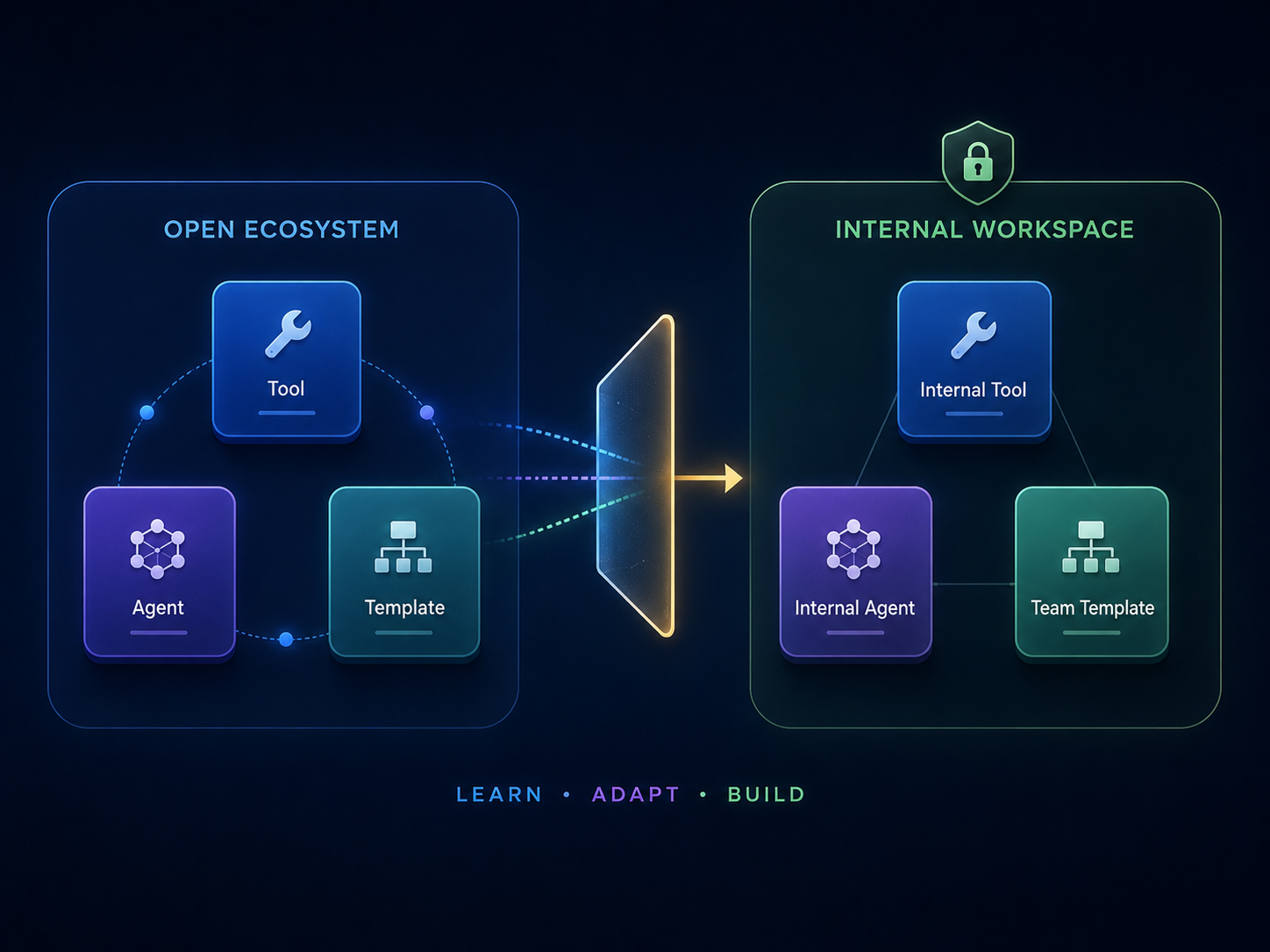
- private agent systems
- open source AI agents
- internal AI tooling
- AI agent packaging
- agent governance
- private namespaces
- agentpm
Open Source vs. Internal AI Agents: Where the Boundary Actually Falls#
The split happens earlier than most teams expect.
A team starts with one useful agent artifact. Maybe it is a tool that wraps a third-party API. Maybe it is an agent that routes support issues. Maybe it is a workflow template that gives every new internal project the same repo layout, lockfile, and deployment hooks. The first version often feels generic enough that it could live in public. The second or third version usually does not.
That is when the boundary shows up.
Some artifacts are broadly useful. They teach a pattern, solve a common problem, or expose a stable interface that other teams can depend on. Other artifacts are welded to the organization that built them. They call private APIs. They encode internal workflows. They know the company’s escalation rules, repo conventions, compliance requirements, and approval paths.
Both categories are valuable. Both deserve to be treated like real software artifacts. They just do not belong in the same place.
That matters more now because teams are no longer experimenting with agents in isolation. One recent set of enterprise data points shows 80% of enterprise applications shipped or updated in early 2026 embed at least one AI agent, up from 33% in 2024.[1][2] But only 31% of organizations report having an agent in full production.[1] That gap is where a lot of private, organization-specific work lives. It is where teams are building the tools, agents, templates, and workflows that make agent systems useful inside a company before they are polished, generalized, or safe to share publicly.
Software teams already know this pattern. Plenty of companies publish open source packages while also maintaining internal SDKs, private libraries, and monorepo packages that never leave the company boundary. Agent systems are creating the same split. They are just creating it faster.
What Open Source AI Agent Artifacts Are Actually For#
Open artifacts solve a different problem than internal ones.
They exist so the ecosystem can learn in public. They reduce duplicated effort across companies. They help teams start from shared infrastructure instead of rebuilding the same integrations and orchestration patterns in parallel. Without them, every team is solving the same agent-system problems from scratch.
That is already visible in adoption behavior. LangGraph alone pulls 34.5 million monthly downloads.[6] Open agent frameworks keep multiplying. Surveys show 57% of organizations prefer building on top of existing tools rather than starting from scratch when they orchestrate agents.[2] That is not a niche preference. It is the normal engineering instinct showing up in a new domain.
Open artifacts are useful when they do at least one of a few things well:
- solve a general problem
- expose an interface that can stay stable across environments
- demonstrate a reusable composition pattern
- teach a piece of agent-system architecture without depending on private context
A generic Slack tool fits. A GitHub issue tool fits. A public research assistant template that shows how to combine search, memory, and a reporting flow fits. A well-scoped agent package that teaches how to compose tools behind a stable contract fits.
Those artifacts are not valuable because they are public for its own sake. They are valuable because they create shared vocabulary and shared starting points. Open artifacts are how the ecosystem learns in public.
The market is growing fast enough that shared infrastructure is not optional. The agent category reached $7.84 billion in 2025 and is forecast to hit $52.62 billion by 2030.[8] That scale does not come from every company building alone. It comes from shared infrastructure that can be adopted, adapted, and improved across teams.
Still, most teams’ most useful work is not what they publish.
Why Teams Keep Their Most Valuable AI Agents Internal#
The artifacts that make agent systems valuable inside an organization are often the least publishable ones.
An internal support agent is useful because it understands the company’s routing rules, customer tiers, escalation paths, and systems of record. A finance workflow is useful because it knows how that company’s approvals work. A deployment template is useful because it matches the organization’s repo layout, CI pipeline, and runtime assumptions. Strip those things out, and you often strip out the reason the artifact existed in the first place.
That does not make the artifact less important. Usually the opposite is true.
EY has talked publicly about deploying an internal agentic AI platform to more than 300,000 professionals across the firm.[3] That is not ecosystem theater. That is internal operational infrastructure. A wealth management firm reported 98% advisor adoption of an internal meeting-notes agent that writes summaries and syncs them into Salesforce.[7] That system is not trying to become a public package. It is valuable because it is deeply specific to the organization using it.
Internal artifacts tend to share a few traits:
- they call private APIs or internal data models
- they encode operational workflows or company policy
- they reflect compliance or governance assumptions
- they require credentials that cannot be shared
- they are still experimental
- they are useful to one team or one company even if they would be noise to everyone else
The mistake is assuming that “internal” means informal.
That is where teams get hurt. Recent security research shows 88% of organizations confirmed or suspected AI agent security incidents across 2025 and 2026.[4] Another data point found 48% of production agents are running with zero monitoring.[4] Shadow AI keeps showing up for the same reason shadow infrastructure always shows up: teams need something useful now, so they build it outside the systems that were supposed to govern it.
The governance gap is even clearer at the identity layer. One 2026 survey found only 21.9% of organizations treat AI agents as independent, identity-bearing entities, while 45.6% still rely on shared API keys for agent-to-agent authentication.[5] That is not only an identity problem. It is an artifact-management problem. When internal tools and agents are treated as loose scripts instead of versioned software with ownership and access control, everything around them gets weaker too.
Internal does not mean less important. It often means closer to where the work actually happens.
The Open-Source-vs-Internal Decision Framework for AI Agent Teams#
The useful question is not whether something should be public forever or private forever.
The useful question is where it belongs right now.
That is a better frame because many good public artifacts begin life as private ones. A team builds a private onboarding template for its own services. After a few months, it learns which parts are company-specific and which parts are generally useful. The internal version stays private. A cleaned-up, generalized version becomes a public template. Tools, integrations, and workflow patterns take the same path regularly.
So the boundary is not a moral line. It is an architectural decision.
The questions that usually cut through it:
- Does publishing this artifact expose internal architecture?
- Does it depend on private APIs, credentials, or internal data models?
- Does it encode business rules or policy that only make sense inside one organization?
- Is the interface stable enough for another team to depend on?
- Would publishing it actually help someone outside the organization?
- Could a sanitized version be public while the original stays internal?
Good public candidates include generic integrations, reusable composition patterns, stable interfaces, and templates that teach a pattern without dragging private assumptions along with them. Good internal candidates include private API tools, team-specific agents, policy-heavy workflow templates, and early experiments that are still changing quickly.
Internal packages in traditional software regularly become open source once teams understand what is truly company-specific and what is general infrastructure. The same path applies to agent artifacts.
That is also why packaging matters. If internal artifacts are going to move over time, they should not live as one-off scripts and undocumented repo folders. They should be versioned and managed well enough that teams can evolve them, share them internally, and eventually extract the parts that deserve a wider audience.
One AI Agent Package Model, Two Access Modes#
A packaging layer that only works for public artifacts leaves teams to manage internal agent systems with ad hoc repos, copy-pasted templates, and informal install instructions. A packaging layer that only works internally misses the compounding value of the open ecosystem.
The better model is one artifact model with two access modes.
That is the approach AgentPM is taking.
Public namespaces support the open side of the ecosystem: tools, agents, and workflow templates that engineers can discover, install, and build on freely. Private user namespaces support solo internal work, experimentation, and early packaging before something is ready to share. Private org namespaces support team-owned internal artifacts with explicit roles, authorized search, controlled installs, and governed publishing.
What stays the same across those modes matters as much as what changes.
The manifest format stays the same. Versioning stays the same. The install and publish contract stays the same. The registry remains the source of truth. Search, package detail pages, install flows, publish flows, namespace pages, and member management all operate on the same artifact model.
What changes is access control:
- public vs. private visibility
- open discovery vs. member-scoped discovery
- open install vs. authorized install
- open publishing for public namespaces vs. role- and entitlement-aware publishing for private ones
That distinction is important because private packaging is not just a UI problem. It is not enough to hide a button or remove a link from the page. The API has to enforce the boundary everywhere it matters. Search has to respect it. Package detail routes have to respect it. Install flows have to respect it. Publish flows have to respect it. Namespace management has to respect it. Otherwise “private” turns into “easy to discover if you know where to look.”
The pricing layer follows that same shape without needing to dominate the product story. Public usage remains free. Pro supports private solo usage. Team supports private org workflows. That is enough for the model to make sense. The real point is not the price card. The real point is that the same artifact model can support both the open commons and internal team systems.
A healthy agent ecosystem needs both.
The open commons helps engineers learn from each other, reuse general infrastructure, and avoid solving the same problems in isolation. Private workspaces help teams turn those patterns into real systems that run against internal data, internal workflows, and internal constraints. One side teaches. The other side operationalizes.
That is the boundary worth respecting.
Not because private work is somehow more serious than public work. Not because public work is only marketing. Because the ecosystem needs both kinds of artifacts, and engineers need a clean way to move between them without changing the underlying model every time.
That is where agent systems start to look less like demos and more like software.
Sources#
- AI Agent Adoption 2026: 120+ Enterprise Data Points. https://www.digitalapplied.com/blog/ai-agent-adoption-2026-enterprise-data-points
- Agentic AI Reaches Tipping Point: 100% of Enterprises Plan to Expand Adoption in 2026 — CrewAI Survey. https://www.businesswire.com/news/home/20260211693427/en/Agentic-AI-Reaches-Tipping-Point-100-of-Enterprises-Plan-to-Expand-Adoption-in-2026-New-CrewAI-Survey-Finds
- Case Study: Building an Enterprise-Scale Agentic AI OS — EY. https://www.ey.com/en_se/insights/ai/building-an-enterprise-scale-agentic-ai-operating-system
- State of AI Agent Security 2026 — Gravitee. https://www.gravitee.io/state-of-ai-agent-security
- The AI Agent Identity Crisis: New Research Reveals a Governance Gap — Strata. https://www.strata.io/blog/agentic-identity/the-ai-agent-identity-crisis-new-research-reveals-a-governance-gap/
- The Best Open Source Frameworks for Building AI Agents in 2026 — Firecrawl. https://www.firecrawl.dev/blog/best-open-source-agent-frameworks
- 12 Agentic AI Examples With Measurable ROI: Enterprise Case Studies 2025–2026 — AI Monk. https://aimonk.com/agentic-ai-examples-enterprise-roi-case-studies/
- 10 AI Agent Statistics for 2026: Adoption, Success Rates & More — Multimodal. https://www.multimodal.dev/post/agentic-ai-statistics
- Enterprise Agentic AI Landscape 2026: Trust, Flexibility, and Vendor Lock-in — Kai Waehner. https://www.kai-waehner.de/blog/2026/04/06/enterprise-agentic-ai-landscape-2026-trust-flexibility-and-vendor-lock-in/